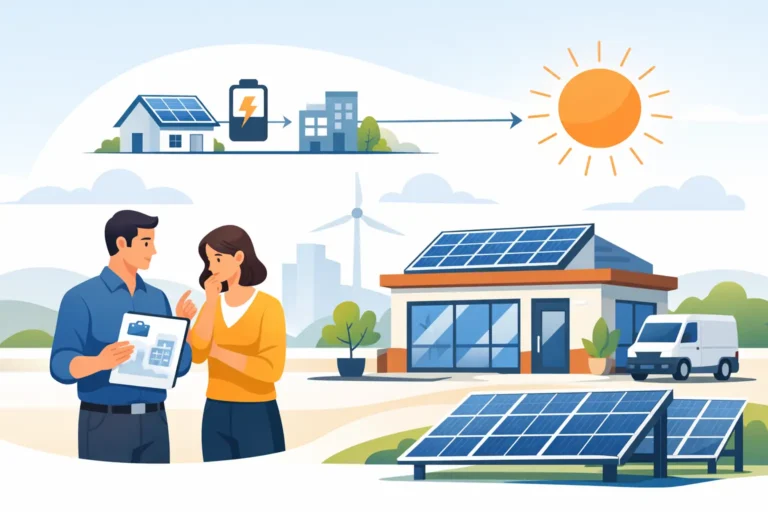
The power bill arriving after a busy month can feel like a penalty for doing well. For cafés, workshops, offices, retailers and farms, electricity is a real operating cost that rises with every refrigerator, machine, computer and air conditioner switched on. This guide to solar for small business is designed to help Australian business owners assess whether solar is the right investment, what size system may suit, and how to make a decision based on sound numbers rather than sales promises.
Solar is not a one-size-fits-all purchase. A system that performs well for a warehouse with daytime machinery may be poorly matched to a restaurant that uses most of its energy after sunset. The best outcome starts with understanding how your business uses power.
Why solar can make commercial sense
A solar system generates electricity at your premises while the sun is shining. When your business uses that power directly, it can reduce the amount of electricity you need to buy from the grid. For many small businesses, this is where the strongest financial benefit sits: avoiding higher retail electricity charges during working hours.
Solar can also help make operating costs more predictable. Electricity prices, network charges and tariff structures can change over time, but generating part of your own power gives you greater control over a significant overhead. For customer-facing businesses, it can also support practical sustainability goals without relying on vague green claims.
The value will depend on your load profile, electricity tariff, roof suitability and local conditions. A business that is closed through the middle of the day may still benefit from solar, but it may need a different system design, export arrangement or battery strategy to make the numbers work.
Start with your energy use, not your roof size
A large roof is useful, but it should not be the first figure that determines system size. Start with at least 12 months of electricity bills, preferably including interval data where it is available. This gives a clearer picture of how much energy your business consumes, when it consumes it and how demand changes across seasons.
Look closely at daytime use. Solar production is generally strongest from late morning to mid-afternoon, although the exact shape of production changes with weather, orientation and the time of year. Businesses with steady daytime loads – such as offices, medical practices, retail stores, manufacturers and rural operations – are often well placed to use solar energy as it is generated.
It is also worth identifying upcoming changes. Are you adding refrigeration, expanding the workshop, fitting out another tenancy or buying electric vehicles? Conversely, are you replacing ageing equipment with more efficient models? A tailored design should account for the direction of the business, not just last year’s bill.
Understanding self-consumption and exports
Self-consumption is the solar power your business uses on site. Exported energy is the surplus sent to the grid. In most cases, using solar yourself is more valuable than exporting it because grid electricity usually costs more than the credit paid for exported power.
That does not mean exports have no value. They can still contribute to overall returns, especially where daytime generation exceeds on-site consumption. But a sensible solar proposal should not rely on overly optimistic export assumptions to look attractive. Ask to see how projected savings are split between avoided electricity purchases and export credits.
Choosing the right commercial solar system
The right system is a balance between annual production, daytime consumption, roof layout, budget and future plans. Bigger is not automatically better. An oversized system may produce more electricity than your business can use or export at a worthwhile rate, while a system that is too small can leave substantial savings on the table.
Your roof needs a proper assessment as well. Orientation, pitch, shading, available space and structural condition all affect what can be installed and how it will perform. North-facing panels are often favourable in Australia, but east- and west-facing arrays can be very useful for businesses with earlier or later energy demand. Spreading panels across different roof aspects may produce a broader generation curve than concentrating every panel in one direction.
Quality equipment matters because commercial solar is expected to work hard for many years. Panels, inverters, mounting systems and protection equipment should be selected for the site rather than treated as interchangeable boxes. The installer should also consider access for maintenance, cable pathways, switchboard capacity, grid connection requirements and the practical look of the finished installation.
For a small business, a clear proposal should explain the proposed system capacity in kilowatts, estimated annual production, likely self-consumption, assumptions behind the savings estimate, warranties and the expected installation scope. If those details are unclear, the quoted price alone tells you very little.
A guide to solar for small business batteries
Batteries are often the next question, particularly for businesses concerned about evening use or power reliability. They store excess solar energy for use later, which can increase self-consumption and reduce dependence on grid power at certain times. They may be particularly relevant for businesses with significant late-afternoon or night-time loads.
However, a battery does not automatically deliver the fastest payback. Its value depends on how much surplus solar is available to charge it, when the stored energy will be used, the business tariff and whether backup capability is needed. A business that already consumes nearly all of its solar generation during the day may see limited benefit from adding storage immediately.
Backup power is a separate design consideration. Not every battery system keeps a building running during a blackout, and not every load can or should be backed up. Critical loads might include refrigeration, communications equipment, security systems, medical equipment or selected lighting. A properly designed backup solution identifies those priorities and sets realistic expectations about how long they can operate.
For regional NSW sites, remote properties or operations where outages create real disruption, an off-grid or hybrid solution may be worth exploring. These systems require especially careful planning around energy demand, generator integration, seasonal production and battery capacity.
Consider costs, incentives and payback honestly
The installed cost of commercial solar varies with system size, roof complexity, equipment choice, access requirements, switchboard upgrades and any battery or backup work. This is why two quotes with similar panel counts can have very different prices and long-term value.
Eligible small-scale solar systems may benefit from Small-scale Technology Certificates, which are commonly applied as an upfront discount. Certificate values and eligibility settings can change, so they should be presented clearly rather than used as a reason to rush a decision. Depending on your location and business, there may also be finance options or other programs worth investigating. Your accountant can advise on tax treatment, depreciation and cash-flow considerations for your particular business.
Payback periods should be treated as estimates, not guarantees. They are shaped by weather, energy consumption, tariff changes, export rates and future electricity prices. A trustworthy assessment uses reasonable assumptions and shows the working, including what happens if your daytime use is lower than expected.
Questions to ask before you sign
A good solar provider should be comfortable answering practical questions. Ask who will design the system and who will install it, whether the proposed equipment is suitable for your site, and what approvals or grid connection steps are included. Confirm the warranty terms for panels, inverters and workmanship, as well as who will support you if a fault occurs years after installation.
It is also sensible to ask whether monitoring is included. A monitoring platform can help you see solar production, identify unusual performance and understand how your business is using electricity. It is useful, but it is not a substitute for a well-designed system in the first place.
Finally, compare proposals on value rather than headline price. The cheapest quote may omit site-specific electrical work, use less suitable equipment or offer limited after-sales support. The most expensive option is not automatically right either. What matters is a system built around your operating needs, with clear assumptions and a provider prepared to stand behind the work.
Plan for the years after installation
Solar is a long-term asset, not a set-and-forget purchase. Panels generally require little routine maintenance, but keeping them clear of substantial debris and checking performance through monitoring can help protect output. If production changes unexpectedly, early investigation is better than allowing a fault to go unnoticed.
Your business may change too. A new tenancy, additional equipment, altered opening hours or electric fleet charging can all shift the value of your energy system. Choosing an experienced partner such as IMS Energy means you can start with a tailored design and have a knowledgeable team to speak with as your power needs evolve.
The best next step is simple: gather recent bills, think honestly about how your business will operate over the next few years, and request a solar assessment that explains the numbers in plain language. A well-planned system should leave you feeling confident about where your energy dollars are going, both now and well into the future.