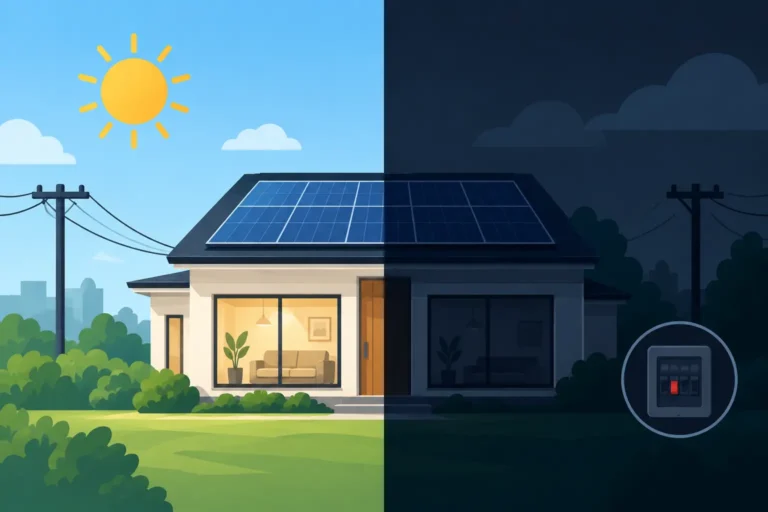
A battery can make a solar system far more useful after the sun goes down, but the biggest battery is not automatically the best buy. For most households, a worthwhile solar battery comparison starts with what happens at your property between 4 pm and 9 pm: how much power you use, when you use it, and whether keeping essential loads running during an outage matters to you.
The right choice should suit your existing or planned solar array, household energy habits, budget and long-term plans. A family with evening air conditioning has different priorities from a couple who mainly wants to avoid buying peak-rate grid power. A regional home that regularly experiences outages may value backup capability above the fastest financial payback.
Start a solar battery comparison with your energy use
Battery capacity is usually the first number people see. It is measured in kilowatt-hours (kWh), which tells you how much energy the battery can store. Yet capacity alone does not tell you how well a battery will serve your home.
Look at your electricity bills and, if available, your smart-meter data. The useful question is not simply, “How much electricity do we use each day?” It is, “How much solar power do we export during the day, and how much electricity do we buy back after sunset?” A battery stores some of that daytime surplus for later, so the evening gap is often the most relevant figure.
For a household exporting 8 kWh on a typical sunny day and importing 7 kWh in the evening, a battery with around 10 kWh of usable storage could be worth considering. But a larger unit may be sensible if electricity demand is likely to grow through an electric vehicle, pool equipment, electric heating or a growing family. Conversely, buying far more capacity than your solar system can regularly charge can leave storage underused.
Nominal capacity versus usable capacity
Check whether a quoted capacity is nominal or usable. Nominal capacity is the total amount of energy physically stored. Usable capacity is the portion available for your home before the battery reaches its protected reserve level. This reserve helps preserve battery health and, on some systems, can be held back for backup power.
Usable capacity is the better figure for comparing day-to-day value. Ask for it in writing as part of every proposal, alongside the expected annual energy throughput and any assumptions used to estimate savings.
Power rating matters when appliances run together
A battery’s power rating, measured in kilowatts (kW), determines how much electricity it can deliver at one time. It affects whether the battery can cover several appliances operating together, such as cooking, lighting, refrigeration and air conditioning.
A 13 kWh battery with a lower power output may store plenty of energy but still draw some electricity from the grid when household demand spikes. On the other hand, a high-power battery can support more loads at once, but it may not be the most economical option for a home with modest usage. Capacity is the size of the fuel tank; power is how quickly the system can supply energy.
Compare backup power, not just battery storage
Many homeowners assume every solar battery will power the house during a blackout. That is not always the case. Some battery systems are installed primarily for self-consumption and savings, while backup operation requires compatible equipment, extra electrical work or a dedicated backup gateway.
A clear solar battery comparison should identify exactly what happens when the grid goes down. Will the battery supply selected essential circuits only, such as lights, the fridge, internet and a few power points? Or can it provide whole-home backup, subject to its power limits? Can the solar panels continue charging the battery during a daytime outage? These details can make a major difference to the system design and price.
Whole-home backup can be valuable, particularly for households relying on medical equipment, working from home, or living in areas where outages are more common. It also requires sensible expectations. High-draw appliances such as ducted air conditioning, electric hot-water systems and large pumps may quickly deplete a battery or exceed its output limit. A tailored backup plan usually focuses on the loads that genuinely matter first.
Battery chemistry, efficiency and installation conditions
Most modern home batteries use lithium-ion chemistry, commonly lithium iron phosphate or lithium nickel manganese cobalt. Lithium iron phosphate batteries are widely valued for thermal stability and long cycle life. Other chemistries can offer a compact footprint or strong energy density. Neither label alone settles the decision, because overall performance also depends on battery management, inverter design, installation quality and warranty terms.
Round-trip efficiency is another useful comparison point. This is the percentage of energy you can retrieve after charging and discharging the battery. No battery returns every kilowatt-hour put into it. Higher efficiency means less solar energy is lost through storage, although a small difference should not outweigh a significant gap in system suitability, backup features or service support.
Where the battery will sit also deserves attention. Australian summers can be tough on electronics. Your installer should assess shade, ventilation, clearances, access, fire-safety requirements and exposure to weather before recommending a location. A neat installation that is easy to service and protected from excessive heat can support reliability over the life of the system.
Understand the difference between AC and DC coupling
If you are adding a battery to an existing solar system, the system architecture matters. An AC-coupled battery has its own battery inverter and can often be a practical choice for retrofits. A DC-coupled battery connects on the solar side of a compatible hybrid inverter, which can reduce conversion steps and may suit a new solar-and-battery installation.
There is no universal winner. AC coupling may offer flexibility where quality solar panels and an inverter are already installed. DC coupling can provide an efficient, integrated design where the whole system is planned together. Compatibility should be confirmed before choosing equipment, particularly if your current inverter is older or if you want backup power.
Compare warranties by the detail behind the headline
A long warranty is reassuring, but it should be read carefully. Battery warranties generally include a time period, a minimum retained capacity and an energy-throughput limit. The throughput figure is the total energy that can pass through the battery during its warranty period.
For example, two batteries may both carry a 10-year warranty, yet one may guarantee a different remaining capacity or allow a different amount of lifetime energy throughput. Check who handles a fault claim, whether labour is included, and whether the manufacturer has a proven Australian support pathway. The product is only one part of the investment. Responsive advice and reliable after-sales support matter when your household power is involved.
Also ask how the system handles software updates, monitoring and internet interruptions. A clear app can help you see solar generation, battery charge and grid use, but it should not become a source of confusion. Good monitoring gives you useful information without making daily energy management feel like another job.
Price, payback and the value of flexibility
Battery pricing should include more than the unit itself. Compare the complete installed scope: battery, inverter or gateway where required, switchboard upgrades, backup circuits, metering, commissioning and any site-specific work. A cheaper quote may not include the same backup functionality, usable capacity or installation standard.
Savings depend on your solar production, feed-in tariff, retail electricity rates, consumption pattern and battery settings. Time-of-use tariffs can make storage more valuable when the battery avoids buying electricity during expensive evening periods. Some households may also consider participating in a virtual power plant, but the conditions, incentives and level of control should be understood before enrolling.
Government incentives and state-based programs can change over time, so they should be treated as part of the current quote rather than assumed. The strongest case for a battery is usually a blend of bill savings, greater energy independence and backup confidence, rather than one headline payback number.
Questions worth asking before you decide
Before accepting a proposal, ask how the recommended capacity was calculated, what your system can power during an outage, and whether future battery expansion is possible. Confirm the usable capacity and continuous power rating, the battery and inverter warranty conditions, and the total installed price.
It is also worth asking whether your existing solar system is compatible, how the equipment will be positioned, and what support is available after commissioning. A good installer will explain the trade-offs plainly rather than push one battery size or brand for every property.
At IMS Energy, battery recommendations are planned around the way each customer uses power, not a one-size-fits-all package. The best next step is to pair your recent electricity data with a site assessment, then choose a system that gives you practical value on ordinary days and confidence when the grid is less reliable.