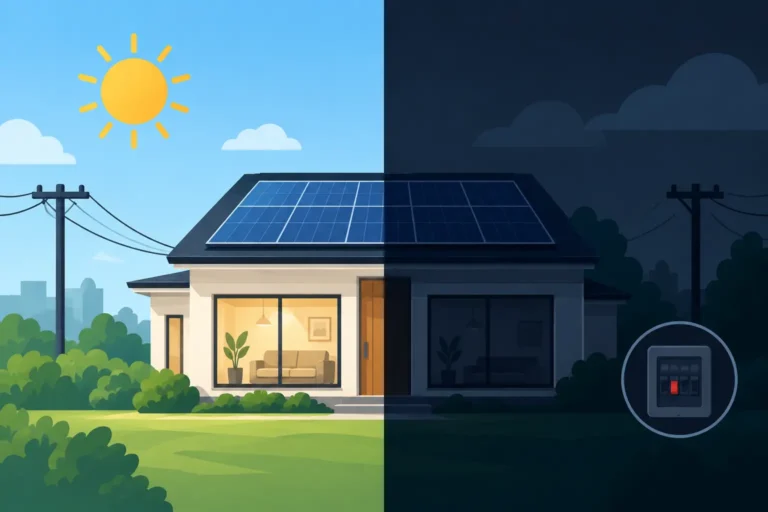
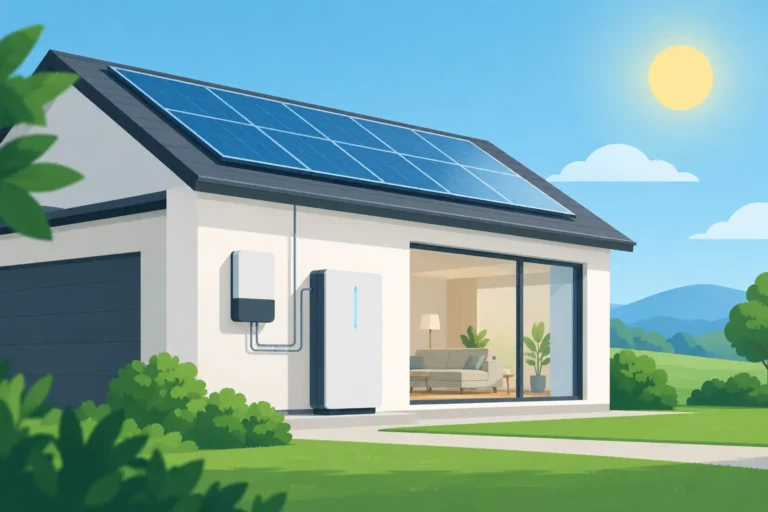
A home battery is not automatically the cheapest way to cut a power bill. But for households with solar, high evening electricity use and the right energy plan, it can turn surplus daytime generation into useful power after sunset. So, do batteries save money? Often they can, but the size of the saving depends far more on your household’s energy habits and tariff than on the battery alone.
The practical question is not whether a battery works. Modern systems work very well. The question is whether the value of the energy you store, plus the security it provides, justifies the upfront investment for your home or business.
Why a battery can lower your electricity bill
Solar panels make the most power during the middle of the day, when many homes are quiet. Without a battery, excess solar is exported to the grid for a feed-in tariff. That payment is helpful, but it is usually much lower than the price you pay to buy electricity back in the evening.
A battery stores some of that surplus solar for later. Instead of exporting electricity for a few cents per kilowatt-hour and then buying power at a much higher retail rate after work, you can use your own stored energy to run lights, cooking appliances, entertainment, heating or cooling, and other evening loads.
That difference between the export rate and the grid import rate is where much of the financial value sits. The more solar energy you would otherwise export, and the more electricity you use after the sun goes down, the stronger the case for storage becomes.
For many Australian households, evenings are the expensive part of the day. People arrive home, prepare dinner, run the dishwasher, charge devices and use air conditioning or heating. A well-sized battery can reduce how much power is bought during these periods, particularly when paired with a solar system that produces reliable surplus generation.
Do batteries save money in every household?
No. A battery is a tailored energy investment, not a one-size-fits-all product. A family that is away during the day, has strong solar production and uses plenty of electricity in the evening may see compelling value. A household that already uses most of its solar while the sun is out may gain less from adding storage.
The same applies to businesses. A business operating mainly in daylight hours may receive greater benefit from adding more solar capacity or improving daytime consumption first. A business with significant early-morning, evening or overnight load may find that a battery plays a more valuable role.
The key factors are your annual electricity use, when you use power, solar system output, current feed-in tariff, retail electricity rate and whether you are on a time-of-use tariff. Your roof orientation, shading and local weather conditions also affect how much surplus energy is available to charge a battery across the year.
The value is highest when you avoid costly grid power
Saving money is not simply about filling a battery every day. It is about using stored electricity at the right time. If your retailer charges more during peak periods, a battery may charge from solar in the day and discharge when grid electricity is most expensive.
Some battery systems can also be programmed to charge from the grid during cheaper off-peak periods and discharge during peak times. This can be useful on suitable tariffs, although it needs careful planning. Charging from the grid may reduce savings if the price difference is too small, and it does not deliver the same clean-energy benefit as storing your own solar generation.
What affects battery payback?
Battery payback is often discussed as a single number, but real-world results vary. It is better to look at a range based on your likely energy use, tariff settings and future electricity prices.
A battery’s installed cost is the starting point, but it should not be viewed in isolation. Consider its usable capacity, efficiency, warranty, expected cycling, backup capability and compatibility with your current or planned solar inverter. A lower upfront price is not always better value if the system has limited usable storage, fewer backup options or does not suit the way your household uses energy.
Electricity prices and feed-in tariffs matter too. As retail power prices rise or solar export payments fall, using more of your own solar becomes more valuable. That said, no provider can honestly promise an exact saving over a decade. Energy rates, household routines and weather all change.
A realistic savings estimate should model your own consumption rather than rely on a generic promise. Reviewing interval data from your electricity bill can show when you draw power from the grid and whether there is enough surplus solar to charge a battery regularly.
Battery size matters more than most people expect
An oversized battery can leave capacity unused during milder weather or low-consumption periods. An undersized battery may fill quickly but provide little support through the evening peak. Neither outcome is ideal.
The right capacity depends on your goals. If the priority is reducing nightly grid imports, the system may be sized around your typical evening load. If you want to support essential appliances during an outage, the design needs to account for which circuits you want backed up and how long you need them to operate.
For larger homes, electric vehicle charging, pool pumps, ducted air conditioning or growing energy needs, a scalable battery may provide a sensible path. Starting with a system that can expand later can be more practical than paying for capacity you may not use immediately.
Savings are only part of the decision
Many households choose a battery because they want greater energy independence as well as lower bills. A battery gives you more control over the solar power generated on your roof. Rather than sending most of it away during the day, you can retain more for your own use.
Backup power is another important benefit, but it needs to be specified properly. Not every battery provides power during a blackout, and not every backup system can run every appliance in the home. Backup capability depends on the battery, inverter, switchboard design and the circuits selected for backup.
For example, a backup-ready system may keep lighting, refrigeration, internet, selected power points and a garage door operating. Running large loads such as ducted air conditioning, electric hot water or multiple high-draw appliances during an outage may require a more capable design and a larger battery.
For regional NSW properties, remote sites and businesses where an interruption can be costly, this resilience may carry real value beyond a simple bill calculation. The right system can help maintain essential operations while the grid is unavailable, provided it has been designed for that purpose.
How to improve the financial case for a battery
Before choosing storage, make sure your solar system is working hard for you. Panels should be appropriately sized, clean and free from major shading issues where possible. Monitoring data can identify whether your home has enough excess generation to justify a battery or whether your priority should be improving solar capacity first.
It also helps to shift flexible electricity use into solar hours. Run the dishwasher, washing machine, pool pump or electric hot water system when your panels are producing, where practical. This increases solar self-consumption without drawing down the battery unnecessarily.
Your energy retailer and tariff deserve just as much attention. A suitable time-of-use plan may improve battery value, while an unsuitable tariff can erode it. Review the full rate structure, including daily supply charges, peak windows, off-peak rates and feed-in tariff, rather than choosing an offer based on one headline figure.
Finally, consider the whole system. Premium solar panels, a quality inverter, correctly installed battery storage and clear after-sales support are all part of long-term value. A battery should integrate cleanly with your current setup and be designed around the way you actually live or operate your business.
Getting a clear answer for your property
The best way to decide whether battery storage makes financial sense is to begin with your electricity data, not a battery brochure. A tailored assessment can compare your solar output with your consumption pattern, estimate likely self-consumption gains and discuss the trade-off between bill savings, backup power and upfront cost.
At IMS Energy, the focus is on designing solar and battery solutions around the property, budget and energy goals rather than pushing a standard package. For some customers, a battery is the next logical step. For others, more solar, better load management or a future-ready battery design may be the smarter first move.
A battery can be a valuable long-term addition when it helps you avoid expensive grid electricity, use more of your own solar and feel better prepared for outages. The worthwhile system is the one sized honestly for your needs, with savings expectations that make sense on paper and in everyday life.