If you’re planning a solar system for a warehouse, office, farm shed or retail site, one of the first practical questions is what size are commercial solar panels. It matters because panel dimensions affect how many modules fit on your roof, how much power the system can generate, and whether the layout will work around skylights, HVAC units and access paths.
The short answer is that most commercial solar panels are larger than residential panels. A common commercial module is around 2 metres long and 1 metre wide, with power output often sitting between 400W and 600W per panel. But that only tells part of the story. The right panel size for your business depends on roof space, structural capacity, energy goals and the way your site uses electricity across the day.
What size are commercial solar panels in practice?
In practical terms, most commercial solar panels are built with either 72 cells in older formats or 108, 120, 132 and 144 half-cut cell designs in newer ones. For Australian businesses, a typical modern commercial panel might measure roughly 1,722mm x 1,134mm, 2,094mm x 1,038mm or somewhere close to that range depending on the manufacturer.
That means commercial panels usually take up about 1.9 to 2.4 square metres each. Weight also matters. Many fall in the 21kg to 33kg range, with higher-output modules often heavier and physically larger. On a wide-open industrial roof, that size can be an advantage because larger panels can reduce the total number of modules needed. On a roof with lots of obstacles, larger panels can make the layout less efficient.
This is where generic answers start to fall short. Two panels might have similar wattage but slightly different dimensions, frame thicknesses or weight loading, and those differences can affect design options.
Commercial vs residential panel size
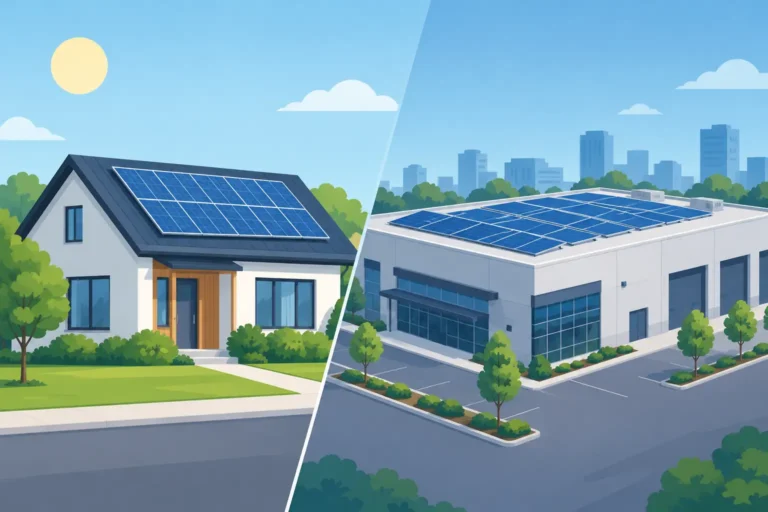
Commercial panels are generally bigger because business sites often have more available roof area and larger energy demands. Residential panels are commonly chosen to suit tighter roof sections, more varied roof angles and aesthetic considerations. Commercial installations tend to prioritise output, installation efficiency and return on investment.
That said, bigger is not always better. If your commercial roof has multiple sections, parapets, vents or shading issues, a slightly smaller panel may allow a better fit and higher total generation across the whole system. This is why system design should start with the site, not just the panel brochure.
Wattage matters as much as physical size
When people ask what size are commercial solar panels, they are often really asking two questions at once: how big is the panel physically, and how much electricity can it produce?
Those are related, but not identical. In general, larger panels can deliver higher wattage because they have more surface area and more cells. Many commercial panels now sit in the 440W to 580W range, although some specialised products fall outside that. Efficiency also plays a role. A more efficient panel can produce more power from a similar footprint, which is useful when roof space is limited.
For a business, the real goal is not choosing the biggest individual panel. It is choosing the panel and system configuration that delivers the best output from your available space while matching your daytime load profile and budget.
How panel size affects total system size
A commercial solar system is sized in kilowatts, not by the number of panels alone. So if you want a 100kW system and you use 500W panels, you would need about 200 panels. If each panel takes up around 2.2 square metres, the raw panel area would be about 440 square metres before allowing for spacing, access clearances and roof obstructions.
This is why panel dimensions have a direct impact on feasibility. A business may have enough roof space in theory, but once you account for setbacks, tilt frames, maintenance paths and equipment, the usable area can shrink quickly.
On some roofs, a flush-mounted system with high-efficiency panels will make best use of the space. On others, a tilt frame may improve performance but require more spacing between rows. There is always a trade-off between density, orientation and maintenance access.
What size are commercial solar panels for different building types?
The answer can vary by site type more than many people expect.
Large warehouses and factories often suit physically larger, higher-wattage modules because they tend to have broad, uninterrupted roof areas. Fewer panels can mean quicker installation and simpler cable runs, which can help keep project costs under control.
Office buildings and shopping centres can be more complex. Plant equipment, roof penetrations and mixed roof orientations may make a mid-sized commercial panel more practical. In these cases, design flexibility is often worth more than squeezing in the largest possible module.
Agricultural buildings are another example. Barns, packing sheds and machinery shelters can be excellent candidates for commercial solar, but rural sites also need to consider wind loading, roof condition and future energy plans such as battery storage, pump loads or cool room expansion.
Roof structure and compliance cannot be ignored
Panel size is only one part of the engineering picture. Larger commercial panels can increase point loads, wind uplift forces and handling requirements during installation. A roof that looks ideal at first glance may need structural review before the final panel selection is made.
In Australia, commercial systems also need to meet electrical, structural and safety requirements. That includes considerations around roof access, fire pathways, isolator placement and network rules. A panel that fits neatly on paper still needs to work within those real-world constraints.
For business owners, this is where tailored advice saves time and cost. Getting the panel size wrong early can lead to redesigns, lower-than-expected generation or avoidable installation issues.
Why standard sizes still vary between brands
There is no single universal commercial solar panel size. Manufacturers design modules around different cell formats, efficiency targets and product lines. Premium brands may offer stronger output in a slightly tighter footprint, while other modules may prioritise lower upfront cost per watt.
That means comparing panels on dimensions alone is not enough. You also need to look at efficiency, degradation rates, warranty support, temperature performance and how the panel integrates with the rest of the system. For many Australian businesses, especially those dealing with summer heat and high daytime usage, performance over time matters more than chasing the cheapest panel on day one.
Should you choose larger panels for your business?
Sometimes yes, sometimes no.
If your site has a big open roof and you want strong output with efficient installation, larger commercial panels often make good sense. They can reduce module count and simplify layout. If your roof is more complex or your business wants to maximise every usable section, a smaller format may allow a better design outcome.
Budget matters too. The best-value system is not always built with the physically largest or highest-wattage panel available. It is the one that delivers dependable generation, suits your load pattern and stacks up financially over the long term.
A good designer will also consider future needs. If your business expects load growth from new equipment, EV charging, refrigeration or extended operating hours, the panel choice should support that broader plan rather than just today’s electricity bill.
The better question is how much solar fits your site well
Asking what size are commercial solar panels is a smart starting point, but it should lead to a more useful conversation about how much solar your site can support and what system design will return the most value.
At that point, dimensions become one decision among several. Orientation, shading, switchboard capacity, tariff structure, energy usage patterns and battery readiness can all shape the final recommendation. For some businesses, the smartest move is a larger rooftop system. For others, it might be a staged installation that leaves room to expand later.
The strongest commercial solar outcomes usually come from matching the system to the business, not forcing the business to fit a standard system.
If you’re weighing up solar for your site, think beyond the panel’s length and width. The right size panel is the one that works with your roof, your usage and your long-term plans, and that is where careful design makes all the difference.